Case study · Apple Swift Student Challenge
Making sleep feel like progress
Hypnos helps college students connect rest with studying through a sleep companion named Hypno. I designed the app and began its SwiftUI implementation for the Apple Swift Student Challenge.
Role
Product designer and iOS developer · solo
Timeline
January 2026 to present · six weeks from research to prototype
Team
Just me, with Claude as an AI design partner
Tools
Figma, Claude, Figma Console MCP, SwiftUI
Context
Apple Swift Student Challenge · consumer health
03 · AT A GLANCE
Research, impact, and lessons.
5
sleep apps audited for patterns
8/8
of testers found their sleep score
160+
mascot expression combinations
Classmates wanted reassurance after a bad night and a link between sleep and study, which pointed me toward a companion-led check-in. I redesigned the home screen, and sleep-score discovery went from two of eight classmates to all eight across two five-second tests. The lesson: test the core interaction before building the full design system. Finding a score is an early result; sustained use and better sleep still need testing.
04 · THE PROBLEM
Students wanted support after a bad night.
A competitive audit of five sleep apps and conversations with classmates changed my starting point. Classmates wanted reassurance and a connection between sleep and study. Another dense dashboard would give them more to interpret.
The concept pairs a sleep-tracking earplug with an app. I focused the interface on a daily check-in, sleep trends, and focus sessions.
05 · THE INSIGHT
Give the data a companion's voice.
I reviewed wearable sleep research to inform the concept's signals and hardware direction.1-3 Those studies informed the design; they do not validate Hypnos or its proposed earplug.
The classmate conversations led to Hypno: a character who responds to the previous night and suggests a next step. I storyboarded the rough-morning check-in before expanding the screens.
06 · BUILDING THE SYSTEM
A clearer brief fixed an unusable first pass.
My first AI-generated token system was a flat list of forty colors. I rewrote the brief with Apple's Human Interface Guidelines, naming rules, and a primitive-to-component hierarchy. That gave the Figma system a structure I could use across the app.
I used warm reds and eggshell for rest, with cooler accents for focus. Hypno shares that palette, so the character belongs in the interface. Expressions had to remain legible at 24 pixels before I added unlockable accessories.
07 · THE EXPERIENCE
Check in, understand the night, start the day.
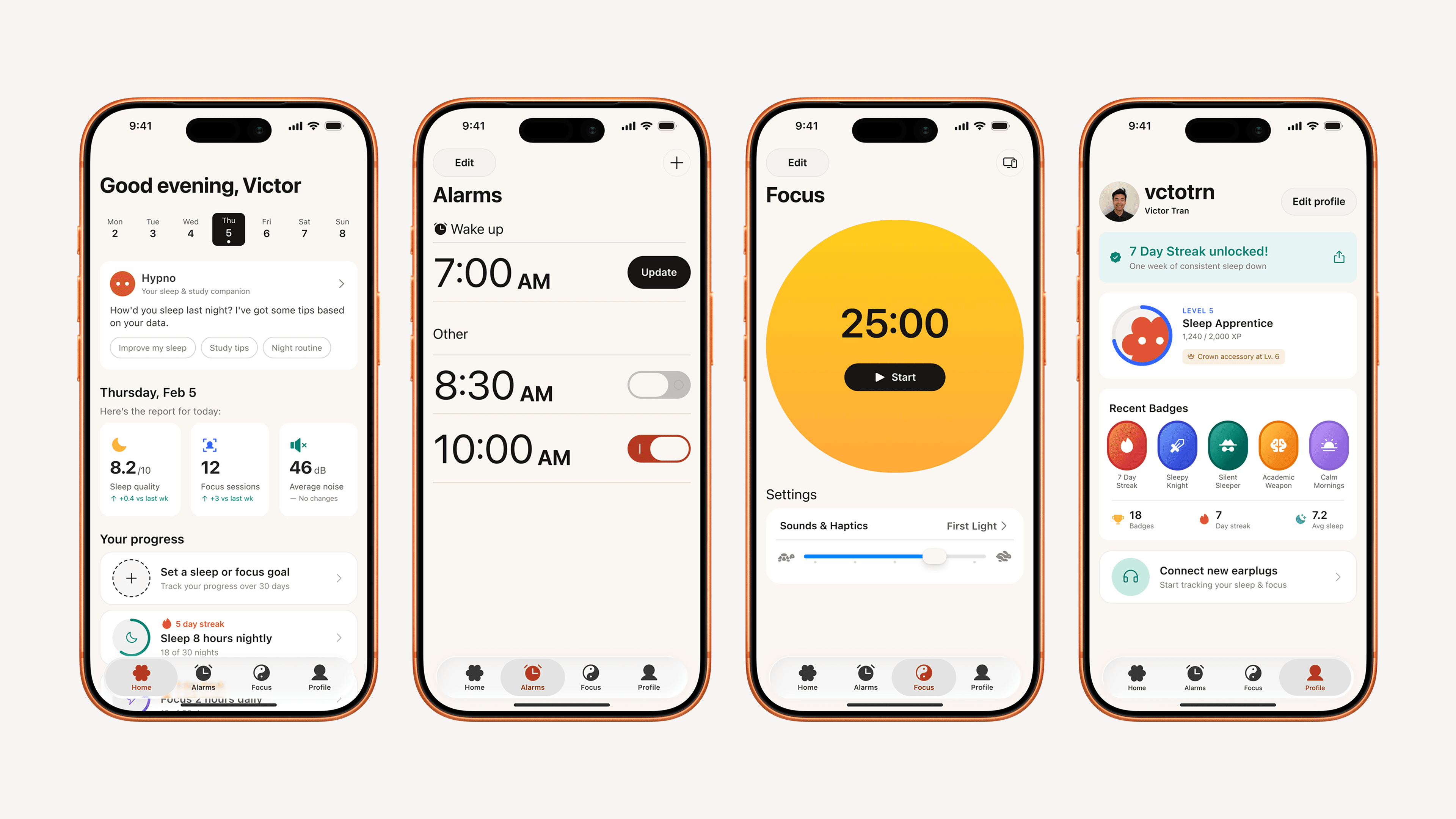
Hypno opens the conversation. Sleep and study streaks connect rest to academic goals, while the focus timer gives students a next action. The screens below show the core loop and supporting tools.
08 · THE TURNING POINT
The sleep score was there. Students couldn't find it.
The first home screen gave two cards equal weight and ended both with “View details.” In a five-second test with eight classmates, only two found the sleep score.
I gave the screen a clearer order: Hypno's greeting and quick replies, three daily metric tiles, then goals and streaks. All eight found the score within seconds in the second round, which was enough to move this layout into the next build.
Iteration loop · home screen
Tested with eight classmates across two five-second tests, the first design failed: only two found their sleep score. I changed it to a companion check-in, three metric tiles, and a separate progress band, and moved on once all eight found the score within seconds in round two.
09 · WHAT COMES NEXT
Finding a score is only the first test.
The redesign improved score discovery in a small prototype test. It does not yet show that students sleep better or keep using the app.
I would test the mascot and streak mechanics earlier, before investing in the full system. Next, I am translating the Figma components into SwiftUI and exploring earplug pairing and Hypno's conversational backend. Retention and sleep satisfaction remain measures to test, not results.
10 · SOURCES
Sources
- de Zambotti, Massimiliano, et al., 2024. Consumer wearable sleep measurement, including in-ear sensing, validated against clinical reference. PubMed 38149978.
- Coutts, Louise V., et al., 2020. Heart-rate variability as a predictor of mental-health states. PubMed 33137470.
- de Zambotti, Massimiliano, et al., 2019. Reliability of individual sleep metrics from consumer devices. PubMed 30789439.